
(A Real Paranormal Encounter… or Something Else?)
I know this isn’t exactly a traditional ghost story , but if you’re someone drawn to paranormal experiences, unexplained encounters, or those strange moments that feel like reality briefly shifts, then stay with me. There’s an overlap here that still unsettles me so I decided to add it to my Blog. And once again, this is a true Paranormal account.
It was the third time my mother had fallen in eighteen months. At 95 years old, I knew we were nearing the end of a long journey. This fall wasn’t as severe as the first two, but it was enough to land her in a nearby nursing home for rehab.
The facility itself was nothing special. Honestly, it felt worn down, like many nursing homes do. But the staff were kind, the rooms were clean, and there was a surprising warmth to the place. The usual harsh smell of disinfectant and urine was absent. Residents gathered daily in the all-purpose room where bingo, painting, and gentle dancing filled the afternoons. It was happy, but in a quietly sad way , still a place suspended between living and leaving.
The residents called themselves “the inmates,” joking about their situation and within two weeks, I knew most of them. The three “L’s,” all in their 60s, all fiercely protective of my mother, whom they lovingly called Nonna. There was Linda, Lori and then Lisa . One had tripped over her cat and broke her hip. She was the friendliest of the three with a head full of frizzy brown hair, the other had bright red lipstick and giggled a lot, and the last was fairly quiet but had an endearing smile which consisted of one single tooth. Don’t ask me who was who, and they sort of travelled together like a three-headed creature.
I visited every day but not because my mother wanted me there. She wasn’t affectionate, and our relationship had always been complicated. But I came to make sure she was safe… and to make sure people knew someone was watching over her.
That’s when I noticed Eduardo.
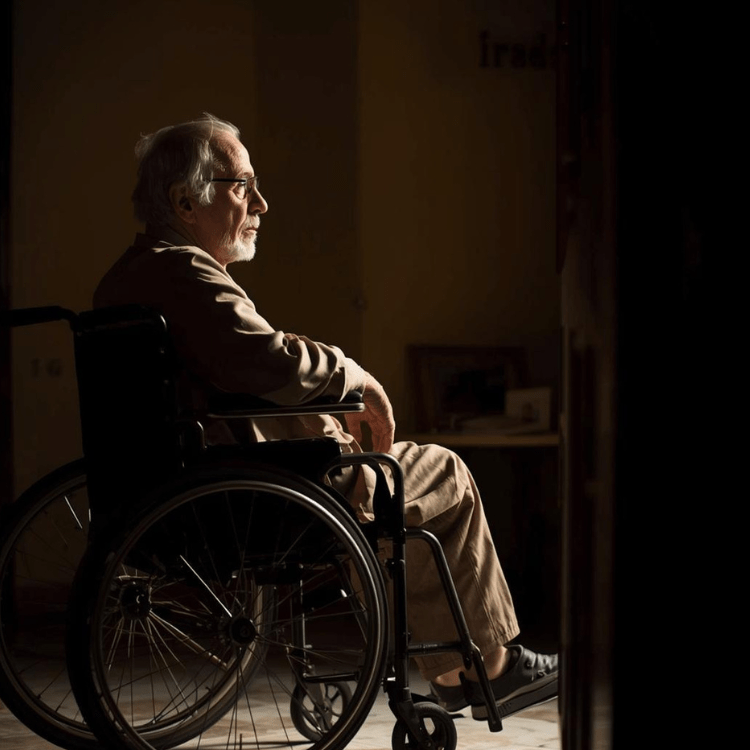
He sat across the room with the men, always neatly dressed, thin bifocal glasses perched on his nose, a small Spanish Bible resting on his lap. Every time I glanced up, he was staring at us, not casually, but intensely. His eyes followed us wherever we went.
At first, I approached his wheelchair out of curiosity, bent over to meet his eyes similar to what one does with a small child and complimented his tiny Bible, surprised he could read such small print.
“That’s a nice Bible,” I said. “What’s your name?”
He leaned in and said slowly,
“¿Cómo puede ser?”
His mouth was slightly crooked, but his eyes were sharp, almost unnervingly clear. There was something unsettling about them, a cold intensity, like he could see through me instead of at me. He seemed agitated and began rambling on in Spanish.
I could pull out some isolated words, but nothing else, so when I noticed he had grown agitated and his voice rose from a whisper to a loud screetch and he reached for my hand, I decided he may have been slightly demented. I grabbed my mother’s hand and walked away keeping her at a safe and steady pace.
.
“He’s saying, ‘How can this be?’”
One of the other residents, one of the three L’s actually, had been watching from across the room and when I walked By she quickly warned me that Eduardo was aggressive and told me to keep my distance. The otehr L’s also reported a similar disposition.
“Oh he’s sharp as a whip, just downright mean.” said the L with one tooth,
“He yelled at one of the nurses because she wouldn;t bring him a gingerale. He’s diabetic you know?” reported the L with bright red lipstick.
Over the next few weeks, I was mindful of his presence in the all purpose room and I quickly realized that wasn’t the man I saw. To me, Eduardo was quiet. If he wasn’t staring at my mother and I, he was looking out the window, or reading from the book of Apocalipsis (Which i later found out was the book of Revelation). He often seemed deeply emotional. Through bits of broken Spanish, we learned he was the same age as my mother, born in the same year, and that he had lost his wife at just 38 years old. He had never remarried, never had children and still wore his wedding ring.
When he spoke of her, tears would fill his eyes. He would grip my hand tightly , uncomfortably tightly , and say softly, “Lo siento en el alma.” I feel it in my soul.
Despite the warnings, I began to feel compassion for him. Sort of an endearment for the ondest man in the residence. He followed us everywhere, wheeling his chair as we walked a turtles pace, to the therapy center, hallways, gathering rooms , always appearing nearby. He would tease my mother, call her endearing names in Spanish, kiss her hand, and joke playfully.
But through it all, he always maintained intense eye contact with me , even if talking to my mother, as if he needed me to witness something.
“El amor jamás muere “ was soemthing else he’d say “Love never dies.”
One day I asked my mother,
“Does he always follow you around like this?”
She answered simply, “Never. Only when you’re here”
Flower Day and The Moment Everything Changed
Every afternoon at 1 PM the staff organized activities. On what would become my last day interacting with Eduardo, residents were making floral arrangements with glass vases, ribbons, fake flowers, essential oils and so on.
My mother watched from a distance, uninterested. Eduardo, the only male resident to join the group, carefully assembled a beautiful bouquet of red and white roses, tied with a pink ribbon. With the help of one of the nurses he added a collection of deep blue crystal stones to the bottom of the glass vase. When done, he wheeled himself over and placed it on our table.
As I helped my mother stand, I felt a small kick under the table.
It was him.
Tears filled his eyes.
“¿Cómo puede ser?”
I tried to smile politely, but then he grabbed my hand firmly. Shockingly hard. The strength felt unnatural for someone so frail. He repeated the phrase over and over, faster now, while pushing the vase toward me.
“¿Cómo puede ser?”
“¿Cómo puede ser?”
Meanwhile, my mother who had decided to stand up on her own had found herself struggling to stay balanced without her walker, or my arm nearby and I couldn’t reach her. HIs grasp was too firm. Panic rose in my chest. An aide finally stepped in, placing a hand on Eduardo’s shoulder. Instantly, his strength disappeared. AS if she had sucked it out of him and his grip loosened. I pulled free.
He was wheeled away, still whispering:
“¿Cómo puede ser? … ¿Cómo puede ser?”
I avoided him after that. Not because I was being mean, but because I felt I was upsetting him.
The Unsettling Revelation
Later that day, one of the L’s Linda with the one tooth, leaned over and said:
“I told you he was a jerk.”
“What was he saying?” I asked.
She shrugged.
“He’s been saying you died at 38. How can he make you beleive that you died. For weeks he’s been saying it. Old fool.”
I froze.
“¿Cómo puede ser?” means How can this be?
Now here’s the part that still chills me.
Eduardo was the same age as my mother. His wife died when she was 38, presumably also the same age as my mother. My mother had me when she was 38 years old.
A Paranormal Coincidence… or Something More?
I’ve wondered: was this simply dementia and coincidence? Or was there something deeper happening , some spiritual connection, a case of mistaken identity across time, or a strange paranormal moment where grief blurred reality?
Nursing homes often feel like liminal spaces , places between this world and the next. Many people who work in elder care talk about unexplained phenomena, residents seeing things others can’t, or moments that feel eerily prophetic.
Was Eduardo seeing his past reflected in me?
Did he think I was someone he lost?
Or was something else entirely happening in that room?
I don’t know.
But even now, when I think of his piercing green eyes and the way he whispered “How can this be?” it feels less like a memory and more like a mystery still waiting to be solved.
 Haunted and Waiting
Leave a comment