
There is a moment which is quiet and fragile. When the surface of the world seems to thin.
And a dark mirror, bowl of still water or a candle flame flicker holds your attention.

My own story?
I’ve never had the experience of scrying. The closest I ever got was when I thought I saw the vision of a person petting my dog one evening. It was a cold winter’s night and I had let her out to run in the back yard. She stopped near a tree and began barking, the condensation from her mouth formed what looked like an arm reaching for her head to pet her. I couldn’t believe it. And the more I stared at it, the more the figure came out, appearing like either a short woman or a child. But as I kept thinking, “this can’t be true” it disappeared (Hence the cursed “FILTER” ). Now that may be more a case of paradeolia than Scrying, but its the closest I’ve ever come to it.
I had a dear friend however who used to hike to this little hidden pond at the top of a hiking area where I live. The pond sat peacefully under a large oak that darkened the water even in the brightest of days. She told me she’d go there often and could see faces in the water if she looked long enough, however couldn’t do it when I was with her. THAT is scrying.
For thousands of years, people have stared into reflective surfaces not to see themselves but to see beyond themselves.
This practice is called scrying, and it may be one of humanity’s oldest and most misunderstood methods of accessing hidden knowledge. Long before psychology had language for altered states and perception filters, cultures across the world discovered the same unsettling truth: when the surface becomes still, something else begins to move.
In this blog, we’re going to explore where scrying comes from, why it appears across nearly every ancient culture, how it frightened religious authorities, and most unsettling of all, why modern experiments suggest it still works.
What Is Scrying?
Scrying is a form of divination that involves gazing into a reflective or translucent surface to receive images, symbols, or messages. Unlike tarot, pendulums, or runes, scrying is passive. You don’t shuffle, cast, or manipulate anything.
You wait.
You allow perception to change.
Common scrying tools include:
- Polished obsidian or black mirrors
- Still water in bowls, wells, or ponds
- Crystal spheres
- Smoke, flame, or oil
- Even shadows—or darkness itself
The goal isn’t imagination.
It’s being receptive and allowing the hidden to creep in.
Practitioners throughout history warned that forcing images ruins the experience. True scrying begins when the mind stops correcting what it sees. What we call the FILTER, the PROGRAM.
Ancient Origins: When Stillness Became a Doorway

Scrying predates written history.
In ancient Mesopotamia, priests gazed into bowls of oil and water to receive divine messages. Egyptian temple rituals used reflective surfaces, sometimes involving children believed to be spiritually “open” or unguarded by rational thought.
The Greeks practiced hydromancy at sacred springs and underground chambers, some so dark that light barely touched the water’s surface. Celtic cultures turned to sacred wells and blackened shields before battle, believing water acted as a threshold between worlds.
Across civilizations separated by oceans and centuries, the same belief emerged independently:
Still surfaces are doorways.
Not metaphors but Thresholds.
Medieval Scrying and Religious Fear

By the Middle Ages, scrying became dangerous—not because it failed, but because it worked outside church control.
One of the most famous practitioners was John Dee, advisor to Queen Elizabeth I. Dee owned a polished obsidian mirror, likely of Aztec origin, and worked with a medium to record visions he believed came from angels. These sessions were logged meticulously, noting dates, emotional states, and outcomes.
Dee believed he was conducting divine science.
But the messages were unsettling. The entities demanded cryptic rituals, strict moral tests, and absolute obedience. Eventually, Dee was branded heretical, and his work slipped into obscurity.
History often frames this as superstition colliding with religion. But the deeper fear was simpler:
Scrying bypassed authority.
It offered knowledge without permission.
How Scrying May Work
Modern psychology offers a partial explanation.
Scrying induces a trance-like state. Gazing into a low-stimulus reflective surface relaxes the brain’s filters. The default mode network activates. Symbolic thinking rises. The mind stops correcting perception.
But here’s the problem with dismissing scrying as mere imagination:
Why do people across time, culture, and geography report the same experiences?
- Faces forming
- Movement within the surface
- Scenes that feel external—not invented
And then… there are the experiments.
The Documented Experiment That Changed Everything
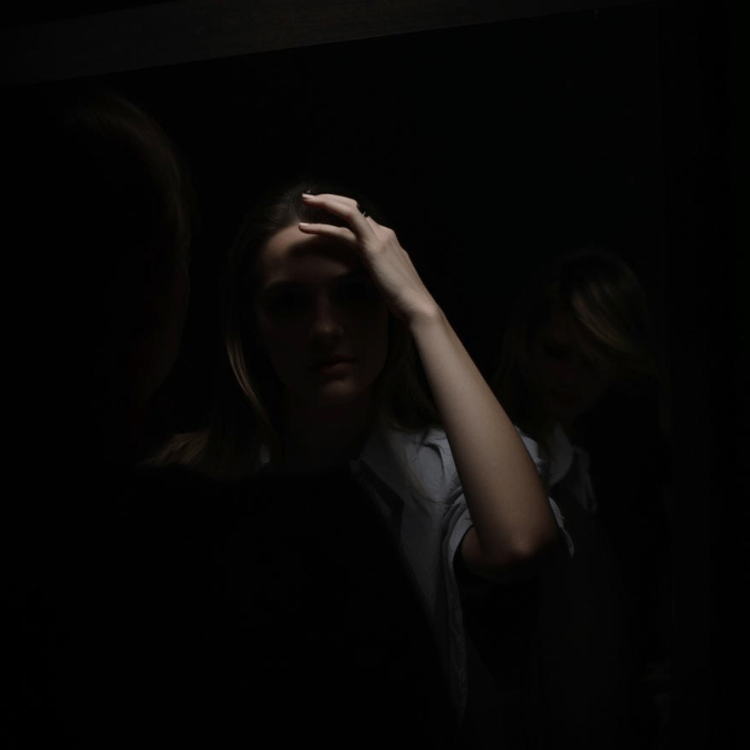
In the 1990s, psychiatrist Raymond Moody conducted one of the most compelling modern scrying experiments.
Moody recreated an ancient Greek structure known as a psychomanteum—a chamber used for mirror gazing to communicate with the dead.
Participants were placed alone in a darkened room.
A mirror was positioned so they could not see their own reflection directly.
They were instructed to relax and gaze past the mirror and not at it.
There were no drugs.
No hypnosis.
No suggestion of what they should see.
The results were shocking.
Over half of participants reported vivid visual experiences. Many saw faces forming in the mirror. Some reported full apparitions stepping forward. Others described scenes, voices, or conversations.
Crucially, participants were not told to expect visions.
Psychologists observing the study noted:
- Participants remained fully conscious
- No signs of mental illness
- No shared expectation bias
Moody later concluded:
“The mirror does not create the vision.
It removes the brain’s resistance to perception.”
Whether psychological or paranormal, the experiment proved something unsettling:
Scrying can be reliably induced.
Scrying in the Modern World
Even today, spontaneous scrying occurs.
People report visions while staring into:
- Dark phone screens
- Windows at night
- Mirrors in low light
Paranormal researchers suggest scrying doesn’t summon images. Instead, it reveals perception.You’re not seeing something new.
You’re seeing what’s usually filtered out.
Scrying in Fiction and Why It Gets It Right
Perhaps the most famous fictional example appears in The Lord of the Rings.
The Palantíri, seeing stones, do not lie. But they reveal partial truth, often driving users toward fear or madness. That detail comes straight from ancient scrying lore.
The danger isn’t false visions.
It’s incomplete ones.
The Thinnest Place of All
Scrying exists at the intersection of psychology, spirituality, and fear. It asks a dangerous question:
What happens when you stop looking at the world and start looking through it?
Whether the visions come from the mind, the soul, or somewhere else entirely, scrying reminds us of something deeply unsettling:
Reality may not be as solid as we think.
And the surface may be the thinnest place of all.
For an Audio version of this Blog Please Search for me on The EyeOpener Society on YOUTUBE or PODBEAN


 Haunted and Waiting
Leave a comment